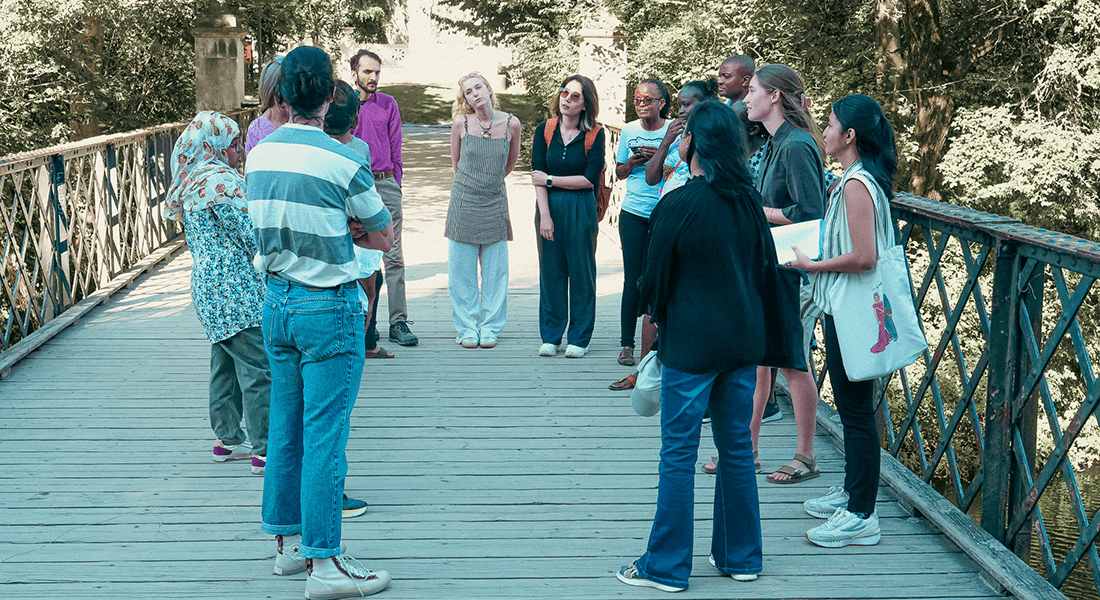
Explores how histories of colonialism continue to shape health, knowledge, and inequality.
Health Walks
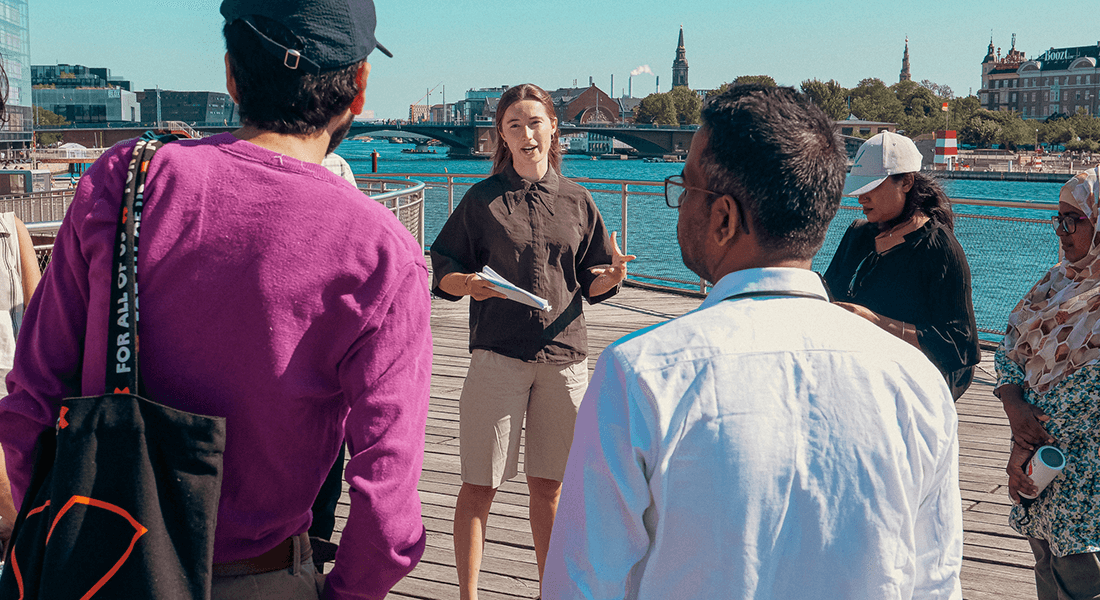
Walk Copenhagen. Rethink Health.
Join a unique exploration of health, power, and technology through the streets of Copenhagen. Our two Health Walks invite you to uncover the hidden systems that shape how we live, move, and thrive. Both walks are freely available as self-guided audio walks on StoryHunt, while the Copenhagen Datawalk can also be experienced as a guided group tour.
Whether examining the colonial histories embedded in public institutions or tracing the invisible data flows that power a smart city, each Health Walk encourages participants to challenge assumptions, ask critical questions, and see Copenhagen in a different light:
Explore Copenhagen through a Health Lens
Hosted by the School of Global Health at the University of Copenhagen, the Health Walks encourage participants to look beyond what is immediately visible and explore the forces that shape health in everyday life. Through walking, discussion, and critical reflection, you will:
- Experience Copenhagen from a new perspective
- Connect historical and contemporary health challenges
- Explore how power, technology, and knowledge shape wellbeing
- Become part of conversations about healthier and more equitable futures
The Health Walks are both available as a free of charge self-guided audio tour, allowing you to explore at your own pace.
The Copenhagen Datawalk is also available as a guided group tour. Get in touch for tour availability and prices.
Download the StoryHunt app to access the Health Walks.
For more information, contact us at sgh@sund.ku.dk
Power, Colonialism, and Health Walk
Our cities serve as living archives of power; recording who produced knowledge, built institutions, accumulated wealth, and defined the meaning of progress.
In Copenhagen, Denmark’s colonial past is embedded in its museums and botanical gardens, but also within the foundational histories of medicine, public health, and the University of Copenhagen itself. Yet colonialism is not simply a story of the past. It actively determined whose bodies, experiences, knowledge, and health were valued, and whose were marginalised.
The Power, Colonialism, and Health Walk invites you to explore Copenhagen through a critical global health lens. Along the route, you will discover how colonial power operated not only through political and economic control, but also through the universalisation of European knowledge systems of observation, classification, and production that laid out the groundwork for modern healthcare.
By examining the fine line between care and control, this walk explores how medicine and public health have often been intertwined with broader systems of power and regulation. Guided by the principle, “Nothing about, without us,” this walk challenges both what we know and who holds the authority to shape the future of health.
This walk was researched and developed by Xenia Klerk Kurpatow.
Resources and literature
Explore some of the resources and literature behind this walk. Upon request we can also provide a full bibliography.
|
Stop |
Theme |
Essential reading |
|
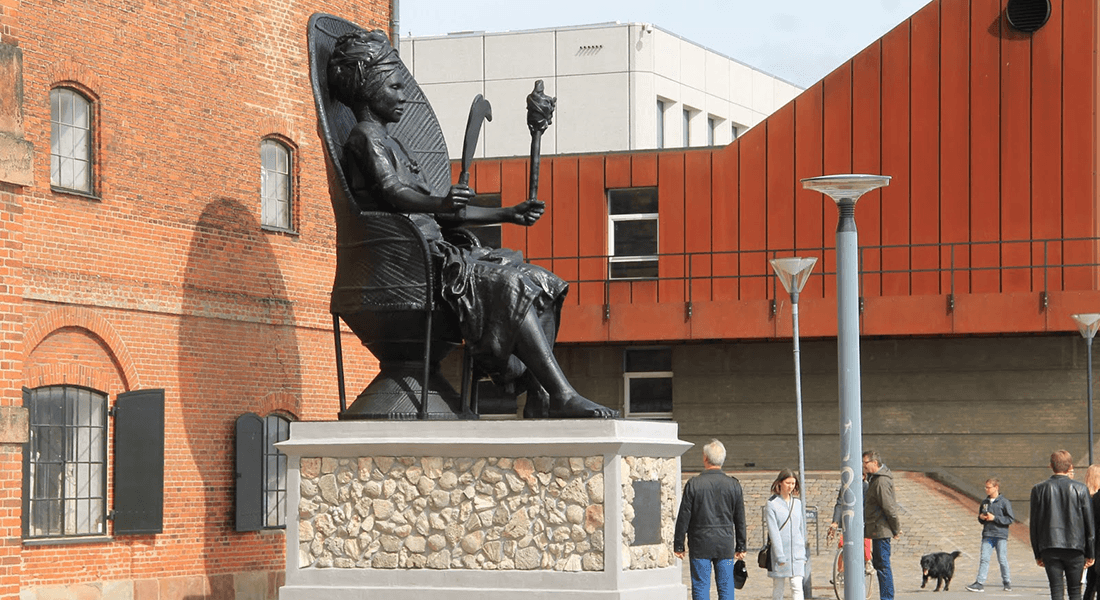
1. I Am Queen Mary / Ghosts in the harbour |
Colonialism as a determinant of health |
Czyzewski, Karina. “Colonialism as a Broader Social Determinant of Health.” The International Indigenous Policy Journal 2, no. 1 (2011): Article 5. https://doi.org/10.18584/iipj.2011.2.1.5. Pai, Madhukar, and Seye Abimbola. “Will Global Health Survive Its Decolonisation?” The Lancet 396, no. 10263 (2020): 1627–28. |
|
2. Designmuseum / Care and control |
Reproductive governance and bodily autonomy |
Ross, Loretta J., and Rickie Solinger. Reproductive Justice: An Introduction. Berkeley: University of California Press, 2017. Rud, Søren. “Governing Sexual Citizens: Decolonization and Venereal Disease in Greenland.” Scandinavian Journal of History 47, no. 4 (2022): 567–86. https://doi.org/10.1080/03468755.2021.1991468. |
|
3. Medical Museion / The bodies that built medicine |
Colonial medicine, race, classification, and medical knowledge |
Anderson, Warwick. Colonial Pathologies: American Tropical Medicine, Race, and Hygiene in the Philippines. Durham, NC: Duke University Press, 2006. |
|
4. Hans Egede / Saving souls |
Missionary governance, morality, and humanitarian rule |
Kaarsholm, Preben, Manuel Barcia, and Jesús Sanjurjo. “From Abolition of the Slave Trade to Protection of Immigrants: Danish Colonialism, German Missionaries, and the Development of Ideas of Humanitarian Governance from the Early Eighteenth to the Nineteenth Century.” Atlantic Studies 17, no. 3 (2020): 337–60. |
|
5. Language Walk / The words we use |
Language, framing, and epistemic power |
Abimbola, Seye. “The Foreign Gaze: Authorship in Academic Global Health.” BMJ Global Health 4, no. 5 (2019): e002068. https://doi.org/10.1136/bmjgh-2019-002068. |
|
6. Kongens Have / A healthy society |
Welfare paternalism, state care, and colonial memory |
Therkildsen, Lasse S., and Lisa Villadsen. “‘We Must Be Happy That Times Are Different Now’: Shaping Colonial Memory in Denmark.” Social Semiotics 34, no. 5 (2024): 782–800. https://doi.org/10.1080/14608944.2024.2340503. |
|
7. Botanical Garden / Who owns a cure |
Knowledge extraction, plants, medicine, and biopiracy |
Schiebinger, Londa. Plants and Empire: Colonial Bioprospecting in the Atlantic World. Cambridge, MA: Harvard University Press, 2004. Tilley, Helen. Africa as a Living Laboratory: Empire, Development, and the Problem of Scientific Knowledge, 1870–1950. Chicago: University of Chicago Press, 2011. |
|
8. Kommunehospitalet / Who gets to be the expert? |
Public health, population governance, and being counted |
Foucault, Michel. Security, Territory, Population: Lectures at the Collège de France, 1977–1978. Translated by Graham Burchell. Basingstoke: Palgrave Macmillan, 2007. Fassin, Didier. Humanitarian Reason: A Moral History of the Present. Berkeley: University of California Press, 2012. |
|
9. Kartoffelrækkerne / A healthy neighbourhood |
Urban health, housing, stigma, and racialised public health |
Rytter, Mikkel. “At the Borders of the CoroNATION: Samfundssind, Muslim Immigrants and Suspicious Solidarity in Denmark.” Ethnic and Racial Studies 46, no. 12 (2023): 2791–2812. https://doi.org/10.1080/01419870.2023.2177119. |
|
10. Rigshospitalet / Whose hospital is it? |
Universal healthcare, borders, legality, and unequal access |
Biswas, Danielle N., Birgit Toebes, Anders Hjern, Henry Ascher, and Marie Norredam. “Access to Health Care for Undocumented Migrants from a Human Rights Perspective: A Comparative Study of Denmark, Sweden, and the Netherlands.” Health and Human Rights 14, no. 2 (2012): 49–60. |
|
11. Panum / Building healthy futures |
Global health education, innovation, agenda-setting, and epistemic justice |
Infanti, J. J., et al. “Student Experiences and Perspectives on Decolonising Global Health Education: A Qualitative Study across Five Nordic Countries.” Global Health Action 18, no. 1 (2025): 2512624. https://doi.org/10.1080/16549716.2025.2512624. |
|
12. Final Reflection / Towards health justice |
Privilege, responsibility, and critical allyship |
Nixon, Stephanie A. “The Coin Model of Privilege and Critical Allyship: Implications for Health.” BMC Public Health 19 (2019): 1637. https://doi.org/10.1186/s12889-019-7884-9. It’s Time to Decolonize the Decolonization Movement: https://speakingofmedicine.plos.org/2021/07/29/its-time-to-decolonize-the-decolonization-movement/ |
Copenhagen Datawalk
Copenhagen is a city quietly powered by data. Across the city, sensors continuously monitor pedestrian flows, traffic, waste systems, and water management. This rich stream of information helps policymakers and urban planners make decisions that affect health, sustainability, and quality of life.
The Copenhagen Datawalk invites you to discover how everyday data is collected, interpreted, and transformed into smart city solutions that reduce pollution, promote active living, and improve wellbeing for all. Along this route, you will visit key locations where Copenhagen’s hidden data flows come to life, illustrating how technology and urban design work together to build a smarter, healthier city.
Inspired by the Datawalk in Brussels, the Copenhagen Datawalk is more than just an educational tour. It is a platform for residents, policymakers, urban planners, health professionals, and curious citizens to reflect on the opportunities and challenges of data-driven cities, and to engage in discussions on how emerging technologies are transforming urban life.
This walk was researched and developed by Sofie Emilie Vejlø Alva-Jørgensen.
Resources and literature
Explore the resources and literature behind this walk:
- Neuroject: Top 11 Smart Cities in the World: 2024 Review https://neuroject.com/smart-cities-in-the-world/
- Gate21: Smart teknologi giver forsinkede busser et forspring: https://gate21.dk/mobilitet/smart-teknologi-giver-forsinkede-busser-et-forspring/
- Gate21: Faktaark: Forbedret punktlighed og sparet rejsetid på strækning i København:
https://gate21.dk/vidensindlaeg/faktaark-forbedret-punktlighed-og-sparet-rejsetid-paa-straekning-i-koebenhavn/ - Københavns Kommune: Mobilitetsredegørelse 2024: https://www.kk.dk/sites/default/files/agenda/9dbcedf3-ad38-4295-bde5-f52df31908cc/57d803bc-6cab-4a33-bf5d-815be1c81297-bilag-8.pdf
- Nordsense: Smart bins: https://nordsense.com/smart-bin-sensors/
- CSL: Luftkvalitet: https://cphsolutionslab.dk/projekter/themes/air
- Brønnum-Hansen: Assessment of impact of traffic-related air pollution on morbidity and mortality in Copenhagen Municipality and the health gain of reduced exposure
- CSL: Air pollution can now be measured locally: https://cphsolutionslab.dk/en/projekter/themes/climate-monitoring/luftforurening-kan-nu-males-lokalt
- Leapcraft: CPH Sense: https://leapcraft.com/da/cph-sense-2/
- Aarhus Universitet: Overvågningsprogrammet: https://envs.au.dk/om-instituttet-1/faglige-omraader/luftforurening-udledninger-og-effekter/overvaagningsprogrammet
- Aarhus Universitet: Luftmålestationer: København: https://envs.au.dk/om-instituttet-1/faglige-omraader/luftforurening-udledninger-og-effekter/overvaagningsprogrammet/maalestationer/maalingerpaastationerne/koebenhavn
- Andersen et al.: Ambient air pollution triggers wheezing symptoms in infants
- State of green: Save water and money: 5 ways to reduce non-revenue water https://stateofgreen.com/en/news/save-water-and-money-5-ways-to-reduce-non-revenue-water/
- UNICEF: Vi sikrer adgang til rent drikkevand: https://www.unicef.dk/international/overlevelse-og-sundhed/rent-vand/
- LEAKman: Globale vandtab - danske løsninger https://www2.mst.dk/Udgiv/publikationer/2022/06/978-87-7038-425-4.pdf
- Agency for Climate Data: The Danish Elevation Model (DK-DEM) https://www.eng.klimadatastyrelsen.dk/data/the-danish-elevation-model-dk-dem
- National risk profile for Denmark: https://www.brs.dk/globalassets/brs---beredskabsstyrelsen/dokumenter/krisestyring-og-beredskabsplanlagning/2020/-national_risk_profile_for_denmark_2017_lowres-.pdf
- Københavns Kommune: Mobilitetsredegørelse 2024 State of Green: Reducing Urban Water Losses: https://issuu.com/stateofgreen/docs/sog_whitepaper_nonrevenuewater_210x297_v11_web?fr=xKAE9_zJGAA&submissionGuid=6a344884-1a04-4fef-89b1-a26291aa46d6
- Københavns Kommune: 8nye intelligente trafikløsninger: https://documentcloud.adobe.com/spodintegration/index.html#
- Jesper K. Thomsen: VMS for cyclists: https://jesperkthomsen.com/Projects/vms-forcyclist
- Cyklistforbundet: Sundhedsfordele ved cykling: https://www.cyklistforbundet.dk/brug-os/virksomheder/viden/sundhed/forskning-og-viden
- Cyklistforbundet: Sundhed for den enkelte: Raskere og længere liv: https://www.cyklistforbundet.dk/brug-os/virksomheder/viden/sundhed/for-den-enkelte
- HOFOR: Hovedrengøring i Københavns kanaler var startskud til populære badesteder:
https://www.hofor.dk/nyhed/hovedrengoering-i-koebenhavns-havn-var-startskud-til-populaere-badesteder/ - Badevand: Teknisk beskrivelse af badevandsudsigten: https://badevand.dk/#collapseSeven
- Harder Lauridsen et al: Gastrointestinal Illness among Triathletes Swimming in Non-Polluted versus Polluted Seawater Affected by Heavy Rainfall, Denmark, 2010-2011: https://journals.plos.org/plosone/article?id=10.1371/journal.pone.0078371
- Østergaard et al: Winter Bathing in Denmark: A Qualitative Case Study on Winter Bathing’s Impact on Mental Health: https://www.mdpi.com/2227-9032/12/20/2076
- MedicalNewsToday: Physical and mental benefits of swimming: https://www.medicalnewstoday.com/articles/321496#whole-body-workout
- Geografisk orientering: COVID-19's geografi: https://www.geografforbundet.dk/media/2809/go1-2021.pdf
- Dataforsyningen: Corona-pandemiens udvikling følges tæt af Statens Serum Institut: https://dataforsyningen.dk/cases/948
- DTU: Movement maps using telco data: https://covid19.compute.dtu.dk/data-description/telco_data/
- DR Nyheder: Coronavirus: Seruminstitut vil tjekke danskernes bevægelser med mobildata:
https://www.dr.dk/nyheder/indland/coronavirus-seruminstitut-vil-tjekke-danskernes-bevaegelser-med-mobildata - Møllgaard et al.: Understanding components of mobility during the COVID-19 pandemic:
https://backend.orbit.dtu.dk/ws/portalfiles/portal/264035053/M_llgaard_Understanding_4_.pdf - Ege et al.: The unseen toll: excess mortality during covid-19 lockdowns: https://www.nature.com/articles/s41598-023-45934-2
- Gardiner et al.: Perspectives of patients, family members, health professionals and the public on the impact of COVID-19 on mental health: https://www-tandfonline-com.ep.fjernadgang.kb.dk/doi/full/10.1080/09638237.2021.2022637#abstract
- Miljøzoner: Om miljøzoner: https://miljoezoner.dk/om-mz/om-miljozoner/
- DR Nyheder: Fra i dag er det forbudt at køre ind i byzoner med gammel dieselbil: https://www.dr.dk/nyheder/indland/fra-i-dag-er-det-forbudt-koere-ind-i-byzoner-med-gammel-dieselbil
- Aarhus Universitet: EVALUERING AF SKÆRPEDE MILJØZONER FOR DIESELPERSONBILER:
https://dce.au.dk/fileadmin/dce.au.dk/Udgivelser/Videnskabelige_rapporter_600-699/SR608.pdf - Miljøstyrelsen: Miljøzoner er med til at forbedre luftkvaliteten: https://mst.dk/nyheder/2024/august/miljoezoner-er-med-til-at-forbedre-luftkvaliteten
Technolution: Smart traffic solutions to make Copenhagen carbon neutral: https://www.technolution.com/move/cases/copenhagen/ - NordSense: Smart Bins: https://nordsense.com/smart-bin-sensors/
- CNN: What are the best cities for swimming?: https://edition.cnn.com/travel/article/worlds-best-swimming-cities/index.html
- State of Green: Nordhavn: The smart urban area of the future: https://stateofgreen.com/en/news/nordhavn-take-a-tour-of-an-urban-area-of-the-future/
- HOFOR: Visionen for bæredygtige byer: https://www.hofor.dk/baeredygtige-byer/vi-skaber-baeredygtige-byer/visionen-baeredygtige-byer/
- Artelia: COMPASS – Ny trafikmodel for hovedstadsområdet: (note: the name in the onedrive older is “COMPASS modellen 2”) https://arteliagroup.dk/Ydelser/compass-ny-trafikmodel-for-hovedstadsomraadet/
- Teknik- og miljøforvaltningen: Besvarelse vedrørende trafimodellen COMPASS: https://www.kk.dk/sites/default/files/2022-09/09.09.22%20-%20svar%20til%20Mikkel%20Skovgaard%20%28%C3%98%29%20om%20trafikmodellen%20COMPASS.pdf
- The Index Project: CITS - Copenhagen Intelligent Traffic Solutions: https://theindexproject.org/award/nominees/1096
- Anund et al.: Threats and violence towards urban bus drivers in Sweden’: Drivers experiences and general recommendations to prevent violence and threats: https://journals-sagepub-com.ep.fjernadgang.kb.dk/doi/full/10.3233/WOR-205277